FAQs — OBaaC:
Combining financial data with climate action is a completely new concept, so it's natural to have questions—or even a little healthy skepticism.
We believe in total transparency. Below, you'll find plain-English answers on how OBaaC protects your privacy, secures your data, and converts individual transactions into collective power.
The Vision & Philosophy
What is OBaaC?
Open Banking as a Community (OBaaC) is a ground-up movement to reclaim consumer financial data and restore your climate agency. For decades, banks and corporations have used your transaction history to target you and maximize their own profits. OBaaC flips the script.
By securely aggregating spending data, we turn individual choices into undeniable proof of real demand for sustainable products, services, and the broader green economy. This collective evidence forces market accountability, drives private investment toward low-emission alternatives, and gives policymakers the mandate they need to pass bold climate regulations.
Rather than waiting for the green economy to arrive through slow political processes, imagine driving real climate action today—directly from your phone or online.
What is the "Out-In" model?
Currently, our political and environmental systems operate on an "In-Out" model. This is a top-down approach where a central authority (politicians, regulatory bodies) tries to push climate policies outward to the public. Because this central point is heavily influenced by corporate lobbyists, these policies are often watered down, scattered, and fail to deliver meaningful change. OBaaC proposes an "Out-In" model. Instead of waiting for top-down action, we start on the outside (individual citizens making sustainable choices). By aggregating our verified transactions, we drive a concentrated force of consensus inward to the center. When politicians see a massive, undeniable block of citizens shifting their actual wallets, it empowers them—and forces them—to pass bolder climate policy.
What do you mean by "Reclaiming Your Carbon Footprint"?
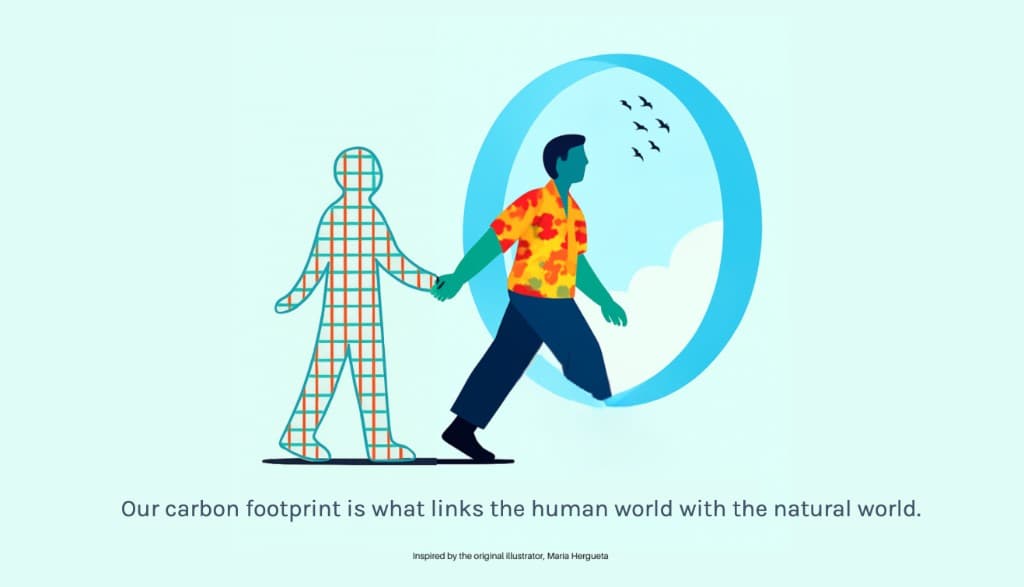
Why do people roll their eyes at the “carbon footprint”?
Because we've all been conditioned to view it as a corporate guilt trip. In 2004, BP popularized the consumer “carbon footprint calculator” as a PR strategy to shift blame onto individuals while they lobbied behind closed doors to block real policy change.
When people dismiss the carbon footprint as Big Oil propaganda, BP wins twice. But here's the truth: Big Oil didn't invent the carbon footprint.
It was created by ecologist William Rees as a scientific tape measure for Earth's natural boundaries. Your footprint was never meant to be an instrument of shame—it is your personal dashboard on a finite planet.
Governments treat “per-capita emissions” as an abstract, top-down statistic. We are taking that number back. By using bank data to measure and aggregate our individual choices, OBaaC transforms the carbon footprint from an invisible burden into a ground-up tool for collective market power.
Privacy, Trust and Technology
How does the financial tracking work? Is it safe?
OBaaC is an open, vendor-agnostic standard that connects via trusted open banking networks worldwide, including Plaid, TrueLayer, Tink, and Yapily.
Never Share Passwords: Authenticate directly with your bank. We never see or store your login details.
Read-Only "Valet Key" Access: Your bank issues a secure token that verifies specific green transactions without ever granting access to move funds or change settings.
Instant Revocation: Turn off data access whenever you want directly from your bank's app.
100% Automated Privacy: Zero human eyes look at your data. Applications like Climate Savers use automated code strictly to match valid purchases or update anonymous leaderboard metrics.
Is my data anonymized?
Yes, completely. Your individual banking data remains strictly private.
Before contributing to any public dashboard, all personally identifiable information (PII) is permanently stripped. Your transactions are aggregated into unified community metrics (e.g., "7,853 collective night train bookings") to demonstrate real market demand.
This turns isolated climate despair into tangible collective agency—without ever exposing who you are.
How to Get Involved
How do I join the movement?
For Advocates & Citizens
- Join r/OBaaC: Take part in community discussions and explore new ways financial data can drive climate action.
- Try Climate Savers (Coming Soon): Register for early access. Link your bank account, opt for sustainable travel and energy choices, and earn rewards while proving market demand.
For Developers & Creators
- Subscribe to the Newsletter: Get the latest technical documentation, developer guides, and open-source standards.
- Build New Use Cases: Propose and collaborate on new applications to expand the OBaaC standard across.
“Small choices, repeated often, shape the bigger picture.”